NOURISHED BY NATURE IN SITKA, ALASKA... GARDENING, FISHING, HUNTING, GATHERING, PREPARING AND PRESERVING
FLOWERS - GROUND COVERS

My definition of a GROUND COVER is any low growing perennial plant that spreads out, a little or a lot, and maintains a healthy, dense cover throughout the season. Once established, ground covers only require a bit of fertilizer in spring and, of course, a little weeding. I can't help but admire and appreciate the tenacity of ground covers. So many reappear year after year requiring so little effort on my part.

We are fortunate to have a lot of workable ground around our home. As with most property in this part of the world, it did not start out that way. An immense amount of energy went into clearing, terracing, stacking wall rock, soil building and soil enrichment. After decades of dedicated labor, most of the ground around our home has transformed into vegetable gardens, flower beds, berry patches and areas with fruit trees. Round and about all of this are perennial flowers and lots of ground covers. The ground cover plants fill openings in rock walls, border many flower and vegetable gardens and spread in low lying corners and spaces. Ground covers are not only attractive, but they also help reduce erosion from our heavy rains.
AJUGA (BUGLEWEED)
Ajuga reptans

The colorful foliage is a delight in itself before bursting with a profusion of purple.


ARABIS (ROCK CRESS, SNOWCAP, WALL CRESS)
Arabis Alpina 'Snowcap'

Years later, I started about two dozen ARABIS plants from seeds in 4" pots. I planted them in the newly renovated upper area in the photo below. Seeds dropped and the lower row grew below the original upper plants. This is how it looked by late spring of the third year.

ARABIS is usually in full bloom throughout the month of May. We were doing some May weeding in the photo below. Notice the black cloth? We sometimes temporarily lay a black construction cloth over some of our garden pathways to hold back weeds.

ARABIS plants drop mature seeds like crazy. The seeds are so tiny and lightweight that some apparently get blown around a bit. Seeds sprout on their own and new plants appear each spring below healthy plants and in random locations throughout the gardens. We always seem to have plenty of little WHITE ARABIS volunteers for sharing. They are usually simple to remove and are not intrusive.

I love it when seeds drop down from the ARABIS growing in some of our tallest rock walls. Instead of waterfalls, we have flowerfalls.

No question that ARABIS is a good choice for Sitka gardens. Look at how dense the flowers have grown. This seems to occur regularly in the rock walls built with vegetable beds above. The fertile soil in the vegetable beds apparently leaches down and nourishes the plants growing in the walls.

After about a month of bloom, the ARABIS petals die off and drift away from the plants. Tiny seed pods begin to develop. They resemble pea pods. The green leaves of the ARABIS remain quite attractive and healthy as the plant grows and spreads itself throughout the summer and into fall.
We have also grown ARABIS in various shades of pink.
Sad to say they have never been as exuberant as the white:
Arabis x arendsii 'Compinkie'
Arabis alpina 'Rose'
Arabis blepharophylla 'Spring Charm'
ARMERIA (SEA THRIFT)
Armeria 'Dusseldorf Pride'


Although it is said to prefer sun, ARMERIA has held up well through the cloudiest and rainiest of summers!
It continuously blooms especially well all summer if you deadhead the spent blooms.
ASTER
Aster oblogifolius "Raydon's Favorite'


Best to be thoughtful about where you plant this ground cover. Although attractive, this ASTER is quick to spread and is intrusive with roots that are difficult to eliminate.

AUBRIETA
Aubrieta x cultorum 'Novalis Blue'

I know. It is not blue. Sometimes it leans towards a shade of blue depending on the lighting.
When my husband built a rock wall where our property meets the road, I thought it would be a good idea to plant something colorful in the spaces between the rocks. I found AUBRIETA 'Novalis Blue' for sale in 4" pots in a local plant shop. I bought a flat.

They were perfect in every way... except that the first few years they were plagued by slugs and aphids. Hmmm. I am not one to pamper plants.
Come summer of the fourth year, I decided I would replace AUBRIETA with less needy plants. Surprise! Upon close inspection, there were no slugs or aphids! AUBRIETA must have overwhelmed the enemy somehow? The AUBRIETA have remained healthy, fit and pest free for decades.
Over the past few years, WHITE ARABIS has found its way into some of the spaces in the AUBRIETA wall. Both ARABIS and AUBRIETA begin to bloom in May. The AUBRIETA bloom endures quite a bit longer than the ARABIS.
Over the past few years, WHITE ARABIS has found its way into some of the spaces in the AUBRIETA wall. Both ARABIS and AUBRIETA begin to bloom in May. The AUBRIETA bloom endures quite a bit longer than the ARABIS.

CARNATIONS (DIANTHUS)
Small flowers... packed with fragrance!
Dianthus caryophyllus 'Grenadin Pink'

Dianthus chinensis
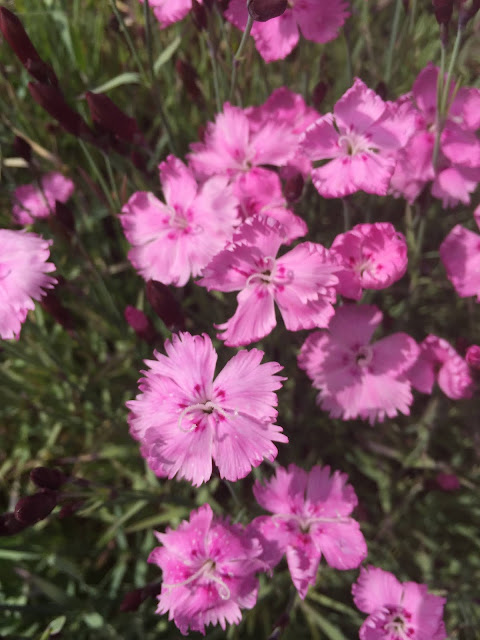

Dianthus plumarius 'Clove Pink'

ENGLISH DAISY
Bellis perrenis
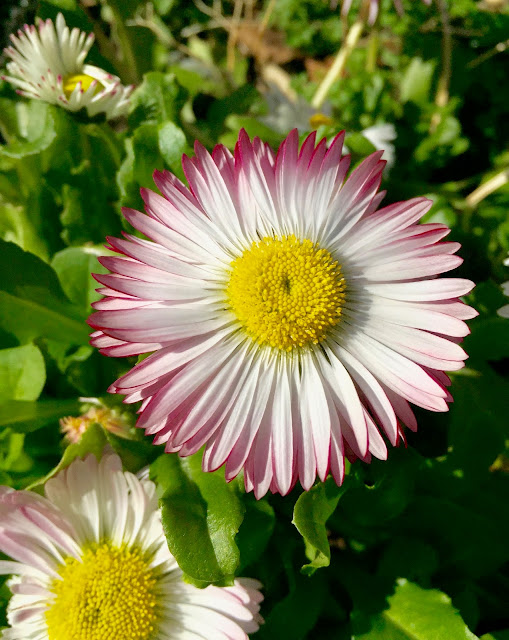

Bellis perennis 'Pomponette'


Some ENGLISH DAISY plants survive the winter. But even if they do not, the seeds drop and countless tiny plants show up each spring in its place. If there is an abundance of tiny, new plants, best to thin them out. Plant the extras in another location. Last year I used the extras to start a patch near the road under a rose bush. I am curious to see how they look this spring.

Also, if time allows, I often pinch off the first show of buds. This can give the plants a chance to amass roots, fill out and then produce a larger number of larger blooms.
HENS AND CHICKS
Sempervivum
We have had a wide variety of HENS AND CHICKS growing in our gardens. I lost track of the names but have a few photos to share. The flowers are often strangely beautiful on thick, tall stems:


LILY-OF-THE-VALLEY
Convallaria majalis

Clothilde Bahovec was a very dear friend. Sometimes she was quite bossy and, to my surprise, it didn't bother me at all! She was a no-nonsense lady who I grew to love the same as if she were a favorite auntie.
I smile thinking about it.
Clothilde had a huge patch of shade loving LILY-OF-THE-VALLEY growing in her yard. After we completed our chicken plans, she took me aside and told me I should grow some LILY-OF-THE-VALLEY along the shady pathway to my entry door. She dug up lots of the plants and told me to bring them home.
I followed her directions and planted them on the north side of the house under an overhang approaching our entry door. A few years later the plants had multiplied and filled in the entire area! We now have a lengthy stretch of LILY-OF-THE-VALLEY to pass by every summer.
I followed her directions and planted them on the north side of the house under an overhang approaching our entry door. A few years later the plants had multiplied and filled in the entire area! We now have a lengthy stretch of LILY-OF-THE-VALLEY to pass by every summer.
 |
| LILY-OF-THE-VALLEY growing around and under PEONIES and below a WISTERIA VINE. |
And what a delight it is to pass by LILY-OF-THE-VALLEY when it is in bloom! The light, fresh fragrance brings to mind youthful years when I would occasionally buy this one perfume named Muguet de Bois. Muguet de Bois translates to LILY-OF-THE-VALLEY!

After filling a bucket or two, I make up several bouquets to share with friends, relatives and neighbors. I offer encouragement to set the bouquet bedside. I am pretty sure LILY-OF-THE-VALLEY induces sweet dreams.

Of course I keep a few bouquets for our own home.

PERSICARIA
PERSICARIA AFFINIS
Persicaria affinis grows well in part sun as well as shade. It spreads gradually and is not intrusive.


Lucky for me, just by chance I planted it in a contained area. Three years later, it filled the area. It overwhelmed all plants in its path.
PERSICARIA MICROCEPHALA
Persicaria microcephala, on the other hand, spreads rapidly and is extremely intrusive. It is difficult to eliminate roots if this ground cover intrudes where it is not welcome.
Because Persicaria microcephala is a uniquely beautiful ground cover, it is irresistible to include it in gardens. But, it definitely needs careful placement. Probably best in a container.
POLKA DOT PLANT (BETHLEHEM SAGE)
Pulmonaria saccharata


SAXIFRAGE (ROCKFOIL)
Saxifraga arendsii

Three shades of Saxafraga arendsii in the photo below:

Saxafraga urbium 'London Pride'


SEDUM (STONECROP)
Sedum Crassulaeceae 'Ruby Glow'

'Ruby Glow' is named for the glowing flowers above so attractive to bees. Below on the left is the growth before 'Ruby Glow' blooms. Chives are on the right.
Both 'Ruby Glow' and Chives are edible.

Sedum rupestre 'Angelina'


SILVERMOUND
(Artemisia schmidtiana)

SILVERMOUND is indescribably soft and fluffy!
It fills an area about 3'x3' beside our LEMON BALM patch.

SNOW-IN-SUMMER
Cerastium tomentosum


Same as the WHITE ARABIS, SNOW-IN-SUMMER spreads nicely. New starts will sometimes pop up here and there from seed. SNOW-IN-SUMMER is not intrusive. It is simple to remove if it is not welcome when it appears unexpectedly.

Not long after the flowers of WHITE ARABIS begin to fade, SNOW-IN-SUMMER begins to bloom. They complement each other very well.

This comment has been removed by the author.
ReplyDeleteGujarat has emerged as a notable manufacturing hub for infrastructure products, including cable protection systems. The state's robust industrial ecosystem, combined with an emphasis on quality and innovation, has made Cable protection covers in Gujarat highly sought after across the country. Many manufacturers based in cities like Ahmedabad, Vadodara, and Rajkot offer customizable solutions for different industries.
ReplyDelete